

Friday, July 21, 2006

Tuesday, July 04, 2006
Today I Drove Behind A License Plate Frame That Said "Pass Da Mic"
 Seeing as how I (i) haven't had time to post anything new, (ii) don't have anything remotely interesting to say, and (iii) can't muster up the energy to get past the ennui preventing me from having anything remotely interesting to say, I'm a-gonna let others do the talkin'.
It Takes a Nation of Millions is in the press a lot again, lately. It's the __th anniversary of said album, and there's yet been another hip hop album (or an album from any genre, really) to match the denseness both musically and politically.
This issue of WaxPoetics features a piece on the Bomb Squad and the making of Nation of Millions, which had two interesting bits: (i) the Bomb Squad made intentional errors in production to give the album a certain vibe, much along the lines of ?uesto playing continously off-beat on many of the Soulquarian albums, and (ii) since the crackdown on sampling (which was due in no small part to the Turtles v De La Soul case - which I happened upon this morning solely because I was trying to place a sample that En Vogue used in "Ooh Child" that De La had used eons ago, a sample so obvious that I'm embarrassed not to know it), hip hop albums have been set in a Dre blueprint, riding on a "groove" pattern of Da Chronic rather than the "music collage" pattern of the Bomb Squad (which, at times during Hank Shocklee's interview sounded alot like Phil Spector's Wall of Sound)(Shocklee also comes across like Brian Wilson sometimes, constantly referring to "the frequencies" and man's base/bass vibrations).
Here's another piece on the album by Soul-Sides pal Hua Hsu from The Boston Globe, and the Stay Free article much referenced in WaxPoetics.
My question is this: given the seeming non-regard for copyright nowadays with the popularity of internet-only remixes, mash-ups, and the old school hip hop mixtape/cd/dvd, what's stopping some underground folk from doing something along the same lines as the Bomb Squad? Lemme know if I've missed the boat on something.
Friday, May 26, 2006
Wednesday, April 12, 2006
Ray Barretto's Acid
 I first heard about Ray Barretto from the inimitable
Soul Sides site, which had claimed Acid to be one of the premier latin soul albums of all time (I'm paraphrasing very loosely here). I take that kind of commendation from Mr. Wang very, very seriously - the guy's an encyclopedia - and sought the album out immediately.
I'm not the best equipped to judge this stuff. My cursory experience with latin/Brazillian music has been purely through the Nu Yorica stuff, a bit of Airto, Brazillian tropicalia. I can pick up the glaring differences between Candido and Tito Puente (the ass shakes in a completely different way), but haven't had time to get into the gritty details between Celso Fonseca and older Caetano material (I'm thinking there's something in Fonseca's pastiche that sounds more romantic and less urgent).
Acid's not hard to sink into, though. The album's fusion of soul and latin groove is pretty immediate. Barretto's various breaks and conga solos are dizzying; the man's got more sense of rhythm and timing than most, without overwhelming the pop element of the composition. It's because of this that I find Acid more appreciable for Barretto's playing than for the soul element of it: the vocals are great, but Barretto's playing is so meaty that the vocals become dressing to Barretto. Being this is Barretto's album, I suppose that's the point.
Monday, March 27, 2006
the Beatles' White Album
 Y'know, I've always been more of a Stones fan than I was a Beatles fan, and, in hindsight, I've really only ever listened to the Beatles out of feeling obligated to the 'canon,' much like one might feel obligated in reading Pound before one reads Eliot or watching Happy Days before Joni Loves Cha Chi.
It certainly doesn't help that I had heard the Clash drum on and on about "phony Beatlemania" well before I had heard Abbey Road. Conversely, it also doesn't help to have the Beatles propped up on a throne by generations before and by classmates that thought Don MacLean's "American Pie" was some sort of fraternal opus. It took me years before I could get around all that sentiment, good and bad, and just listen to the Beatles as the Beatles, as some band out of the UK that have a lot less records (but a lot more compilations) than one would assume.
My first impression upon really listening to the Beatles was that they were an incredibly dorky band. There's really only so many "serious" hits, certainly a lot less than the Beatles' mythical status might imply, and it can be surprising at first as to how much pure bubble-gum the Beatles churned out.
For whatever reason, that's one of the main reasons why the Beatles' early catalog turns me off completely. The sheer fluff of "She Loves You, Yeah Yeah Yeah" and "I Wanna Hold Your Hand" seemed so sterile (especially considering Mick and Keith were regularly sodomizing each other - even if only in a musical sense - by the same point) that I still can't really bother with it (which could also explain why I hate the Ringo songs with such passion).
But with the latter half of the catalog, it somehow, all of a sudden, seemed a little more forgiveable, especially considering that the fluff got cryptic and complex at the same time. I mean, "Happy Birthday" might really just be, um, about somebody's birthday (maybe it isn't), but it really doesn't matter. There's enough meat behind the fluff to make it worthwhile, enough perfect power-pop to make it palatable.(That's not to say some of it isn't self-serving wank. "Piggies" is pretty tortuous to listen to, and let's face it, "Revolution 9" ain't exactly revolutionary either forty years after the fact (was it even at the time, outside of a pop cultural context?))
It's enjoyable stuff, to be sure, but does the White Album actually belong in a canon? Would it be sacrilegious to assume otherwise? Take the time context out of it (in terms of resulting influence, effect, etc), and it's unclear. There's not enough going on to reward the listener with each and every listen (in the same way that Pet Sounds might, for instance); there's not enough being said to alert or shock the listener with each and every listen (in the same way that It Takes a Nation of Millions) might, for instance); there's not enough emotional or spiritual departure to overwhelm the listener with each and every instance (in the same that A Love Supreme might, for instance). What one's left with, then, is a very infectious power-pop album, with few misses (if any), and while that it itself is difficult feat, I'm not entirely sure if, Beatlemania aside (phony or not), this should still cut it. It might have formed a mould, but what broke the mould afterwards might be better in the long run.
Wednesday, March 22, 2006
Beats International's Excursion on the Version
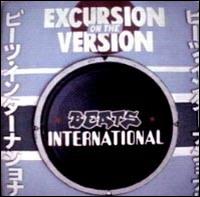 I like the guy, and thus I hate to say it, but Norman Cook hasn't been able to churn out much without it sounding incredibly dated. Be it the Housemartins, Fat Boy Slim, or this early 90's project, the Beats International, all of it comes with an early best before date, with only the odd occasional single here and there being able to stay current for longer than five years.
One of those odd exceptions was Beats International's "Dub Be Good to Me" from the debut album Let Them Eat Bingo, which was Cook's cover of the SOS Band's "Just Be Good To Me" mashed with the Paul Simenon's bassline from the Clash's "Guns of Brixton." That was effectively a no-brainer, seeing as how both of those singles in themselves proved timeless.
Unfortunately, then, Cook couldn't produce anything remotely as catchy on Excursion on the Version (I bought the album because I couldn't remember the name of "Dub Be Good to Me" when I was shopping at the used record store). The album follows largely the same formula as all of Cook's post-Housemartin output (i.e. sample obscure songs to death), but focuses heavily on reggae/ska vibes, all in that sort of late-80's/early-90's filter that makes everything sound overly produced, overly polished, and overly plastic (it's as though that time period forgot about bass altogether and pushed everything through tweeters). It's all very bicycling shorts/Dwayne Wayne sunglasses/faux dreadlocks, if you catch my drift. This might have sounded good at the time (though I somehow doubt it, when compared even to Cook's better project at the time, Freakpower), but its done nothing but bloat in excess fifteen years after the fact.
Tuesday, March 21, 2006
the Bar-Kays' Best Of...
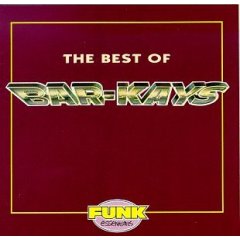 There's no shortage of praise I can heap onto Issac Haye's Hot Buttered Soul - it's clearly one of my favorite albums of all time. Backing Issac Hayes on that album was the Bar-Kays, who had miraculously survived despite having most of its founding members pass away in the same plane crash that claimed Otis Redding (the Bar-Kays had since replace Booker T and the MG's as Redding's backing band, becoming the second rung house band for Stax Recrds). For whatever reason, though, I didn't pick up on the Bar-Kays until much later, and, to be honest, I haven't listened to this compilation in any substantial way until this past week.
This is mostly because I had a severe avoidance for late 70's, early 80's funk/rnb when I had bought this compilation, decidedly concentrating solely on late 60's, early 70's funk ala the JB's and the like. This compilation, comprised of the Bar-Kays output on Mercury Records, is '76 onward (thus ensuring the absence of "Soulfinger," the Bar-Kays only unabashed hit).
It wasn't until a little while back that I'd really come to appreciate funk/rnb from that time (eg Zapp & Roger, Lowrell, Heatwave, etc) as anything other from novelty, and thus I've only just begun to give this Bar-Kays comp a fair shake. For the most part, they're not as way-out as Funkadelic/Parliament or as West Coast synth as Zapp & Roger were, and mostly reflect the post-disco funk that the Isley Brothers and Rick James were putting out around the same time. It's solid stuff, but still somewhat unremarkable, and thus most of the tracks side with the glut of the output from that period of time. There's a few gems ("Hit and Run," "Shake Your Rump to the Funk," etc), but nothing so earth-shattering so as to make any of the material essential...much like the Isley Brothers etc output from the same period. It's perhaps telling, then, that funk really didn't progress beyond this or past Prince.
Thursday, March 16, 2006
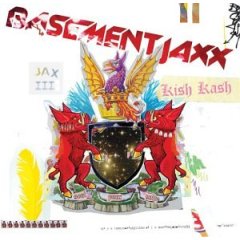
Basement Jaxx's Kish Kash
 It's easy to dismiss club music as weightless, but it's really some of the most utilitarian music around. Many get lost in trying to find hidden depth or meaning to the genre, overlooking it's primary purpose: it's music to dance to!
Granted, there's a horrible amount of shite out there that's so undigestable that it deserves rampant criticism, but it's still rooted to that primary purpose. That glut of horrible club music is horrible for the fact that it's so cheesy that no person with any shame would feel comfortable dancing to said music. When club music is good, then, it's good solely because, man, you really, really want to shake ass to the shit. When club music becomes excellent, then, it's excellent because, well, you really, really want to _____ to this shit.
Basement Jaxx have always been forerunners of the genre because, for the most part, they understand this objective completely. It's rare to find a single that doesn't have its adrenaline ramped up to steroid-dependent level, while somehow avoiding the druggy and relatively aggro sound of the more revered Chemical Brothers. This might because the duo rely so heavily, particularly on Kish Kash, on 80s Prince, updating it with post-Outkast beat programming, wherein each beat sounds overly anxious to get to the next. The programming is where Basement Jaxx deserves much credit, as the two are forward thinking enough so as to achieve a rarity in club music: their albums don't sound overly dated.
The Prince homage gets particularly heavy with the only slow songs on Kish Kash - indeed one of the few slow songs in the Basement Jaxx catalog - "Feels Like Home," featuring MeShell Ndegeocello, who's been having a habit of turning everything she appears on to gold. The song's been often panned for being too blatant of a Prince rip-off, but let's face it, we're not talking about D'Angelo or Andre 3000 here, and relative to both Basement Jaxx and the genre, it's a huge achievement.
Kish Kash, like all of Basement Jaxx's output, is solid fun, and that's a huge achievement as well. It's hard to do fun without achieving the juvenile as well, and Basement Jaxx does so. It might not be earth-shattering stuff, but when one can finally put everything else aside and just friggin' dance, it's excellent.
Tuesday, March 07, 2006
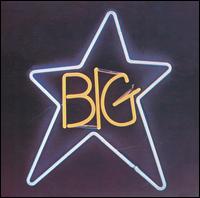
Big Star's #1 Record and Radio City, Chris Bell's I Am the School
Starting the 'B's with trepidation, tackling an elephantine presence from the get-go.
 When I first started writing at ___ magazine, the Big Star/Posies thing had just released the Columbia live album, and a huge flowchart of the Big Star history, tracing through their latter disciples (often 25 years after the fact), graced the walls. This chart weaved around every important band of the past thirty years, broad enough to capture underwhelming 70s bands and overblown 80s juggernauts, each hinging on the theory that a few arpeggio chords could cross the gamut.
And it really did: Big Star's cult status (what with a lack of real commercial success, even to this day) is of massive proportions. Those jangling arpeggios generated some of the most perfect power pop in history. Aside from Emitt Rhodes, it's difficult for me to really think of any other American entity that really perfected the post-McCartney/Lennon power-pop in the 70s (I await someone to challenge me with Cheap Trick).
I received #1 and Radio City as a Christmas gift (thanks James!), both contained on the same CD. For whatever reason, I've always listened to #1 a bit more, and remember it quite a bit more clearly than Radio City. Once one reaches "The Ballad of El Goodo," hears Alex Chilton sing "I've been trying hard against unbelievable odds," the harmonies coming in shortly after, one gets hooked. The opening half of #1 is immediate and drawing, addictive. Bell and Chilton alternate between classic rock riffs, and sweet, almost naive ballads (Chilton has the cockiness of an adolescent when he sings "tell your dad what we said about the Rolling Stones" on "Thirteen"), with "India Song" being the only real dud (it's perhaps telling that it's one of the songs on the album that the Chilton/Bell team didn't pen). #1's got all the hallmarks of an amazing debut: broad, almost a little too ambitious.
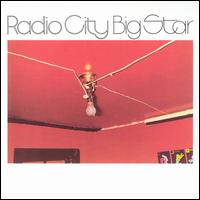 Radio City, then is the excellent follow-up. With Bell having departed from the band due to depression or what not, Radio City is all Chilton, and it certainly helps that Chilton's one of the more intriguing personalties in rock and roll history. Radio City's more biting, the songs more ascerbic. Even when Chilton's heavily in love, it can still sound like he's sheerly bewildered at such an accomplishment. Radio City lacks the innocence of #1, making it perhaps a more mature album in theme, and probably a bit more cohesive, though Chilton's just conflicted enough to still capture the schizophrenic beauty of #1.
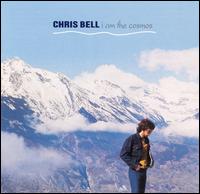 It's not overly surprising, then, to find that Chris Bell's I Am the Cosmos is a sweeter, nicer affair. Though Bell might be the Lennon of the duo in regards to sound (maybe Harrison is more accurate), he's more the McCartney in terms of theme and lyric. If Chilton's the realist, Bell's the dreamer; if Chilton is conflicted with you, Bell is conflicted with himself. Though released post-humously (Bell died in a car crash in '78), I Am the Cosmos still sounds fully realized. It's a bit less 'American' (I suppose living in Memphis will do that) than Chilton tends to be, a bit more clearly evolved from latter Beatles, and thus perhaps a little less immediate in terms of huge guitar riffs and what not. It's still just as beautiful, though, and it's a shame that this will be Bell's only testament.
 When I first started writing at ___ magazine, the Big Star/Posies thing had just released the Columbia live album, and a huge flowchart of the Big Star history, tracing through their latter disciples (often 25 years after the fact), graced the walls. This chart weaved around every important band of the past thirty years, broad enough to capture underwhelming 70s bands and overblown 80s juggernauts, each hinging on the theory that a few arpeggio chords could cross the gamut.
And it really did: Big Star's cult status (what with a lack of real commercial success, even to this day) is of massive proportions. Those jangling arpeggios generated some of the most perfect power pop in history. Aside from Emitt Rhodes, it's difficult for me to really think of any other American entity that really perfected the post-McCartney/Lennon power-pop in the 70s (I await someone to challenge me with Cheap Trick).
I received #1 and Radio City as a Christmas gift (thanks James!), both contained on the same CD. For whatever reason, I've always listened to #1 a bit more, and remember it quite a bit more clearly than Radio City. Once one reaches "The Ballad of El Goodo," hears Alex Chilton sing "I've been trying hard against unbelievable odds," the harmonies coming in shortly after, one gets hooked. The opening half of #1 is immediate and drawing, addictive. Bell and Chilton alternate between classic rock riffs, and sweet, almost naive ballads (Chilton has the cockiness of an adolescent when he sings "tell your dad what we said about the Rolling Stones" on "Thirteen"), with "India Song" being the only real dud (it's perhaps telling that it's one of the songs on the album that the Chilton/Bell team didn't pen). #1's got all the hallmarks of an amazing debut: broad, almost a little too ambitious.
 Radio City, then is the excellent follow-up. With Bell having departed from the band due to depression or what not, Radio City is all Chilton, and it certainly helps that Chilton's one of the more intriguing personalties in rock and roll history. Radio City's more biting, the songs more ascerbic. Even when Chilton's heavily in love, it can still sound like he's sheerly bewildered at such an accomplishment. Radio City lacks the innocence of #1, making it perhaps a more mature album in theme, and probably a bit more cohesive, though Chilton's just conflicted enough to still capture the schizophrenic beauty of #1.
 It's not overly surprising, then, to find that Chris Bell's I Am the Cosmos is a sweeter, nicer affair. Though Bell might be the Lennon of the duo in regards to sound (maybe Harrison is more accurate), he's more the McCartney in terms of theme and lyric. If Chilton's the realist, Bell's the dreamer; if Chilton is conflicted with you, Bell is conflicted with himself. Though released post-humously (Bell died in a car crash in '78), I Am the Cosmos still sounds fully realized. It's a bit less 'American' (I suppose living in Memphis will do that) than Chilton tends to be, a bit more clearly evolved from latter Beatles, and thus perhaps a little less immediate in terms of huge guitar riffs and what not. It's still just as beautiful, though, and it's a shame that this will be Bell's only testament.
Thursday, March 02, 2006
Oopsy: Archive's Londinium
Was looking through the 'B' CDs this morning and found, yep, one last 'A' CD.
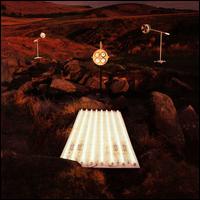 Since Massive Attack's Mezzanine came out, I've written extensively about how trip hop, as a genre, had run its course. Save for aforementioned Massive Attack, a glut of trip hop had been released following the success of the various Bristol acts, and we were thus introduced to a whole new wave of coffee table music suitable for retail stores, bistros and nicer dental clinics.
Lost in that fat was Archive. Londinium, their debut, was lost to the excess. This was undeserved, because, as an album, Londinium is much more cohesive and flowing than the majority of trip hop albums, with uniformity perhaps its only fault.
Londinium works mostly because the production's just sharp enough to capture interest, but not to the point of being jarring. The group behind this are as equally skilled on their string arrangements ("Organ Song" is a great string piece)as they are on their computer programming, and thus Londonium sounds more mature than the tier two Bristol trip hop acts like Purple Penguin or the Sneaker Pimps. Unlike other trip hop outfits, Archive aren't overly dependent on their vocalists, who, despite doing a good job, don't have the signature of a Beth Gibbons or a Martine Topley Bird to make them quintessential to the product.
It's a shame, then, that Archive never mustered more attention than they did. The album stands up to much of the 'classics' of that period, and it's too bad they never got a better push from Island Records than they did.
 Since Massive Attack's Mezzanine came out, I've written extensively about how trip hop, as a genre, had run its course. Save for aforementioned Massive Attack, a glut of trip hop had been released following the success of the various Bristol acts, and we were thus introduced to a whole new wave of coffee table music suitable for retail stores, bistros and nicer dental clinics.
 Lost in that fat was Archive. Londinium, their debut, was lost to the excess. This was undeserved, because, as an album, Londinium is much more cohesive and flowing than the majority of trip hop albums, with uniformity perhaps its only fault.
Londinium works mostly because the production's just sharp enough to capture interest, but not to the point of being jarring. The group behind this are as equally skilled on their string arrangements ("Organ Song" is a great string piece)as they are on their computer programming, and thus Londonium sounds more mature than the tier two Bristol trip hop acts like Purple Penguin or the Sneaker Pimps. Unlike other trip hop outfits, Archive aren't overly dependent on their vocalists, who, despite doing a good job, don't have the signature of a Beth Gibbons or a Martine Topley Bird to make them quintessential to the product.
It's a shame, then, that Archive never mustered more attention than they did. The album stands up to much of the 'classics' of that period, and it's too bad they never got a better push from Island Records than they did.
Subscribe to:
Posts (Atom)